
Permitted Development Rights Explained for Homeowners in Preston and Lancashire
If you are planning an extension in Preston, Fulwood, Broughton, Penwortham, Standish, Ormskirk or elsewhere in Lancashire, one of the first questions is usually: do I need planning permission?
Often the answer is no — but only if the work stays within permitted development (PD) rules. Those rules are national, detailed and easy to get wrong. This guide explains how they work in England in 2026, what is different in parts of Lancashire, and when you still need to apply to the council.
This is general guidance, not a substitute for checking your own property. Planning law can change, and every house is different.
What permitted development actually means
Permitted development rights are a national grant of planning permission. They come from the Town and Country Planning (General Permitted Development) (England) Order 2015 (the GPDO), as amended.
If your project meets every relevant limit and condition, you do not need a full planning application. You still need Building Regulations approval. Planning and Building Control are separate.
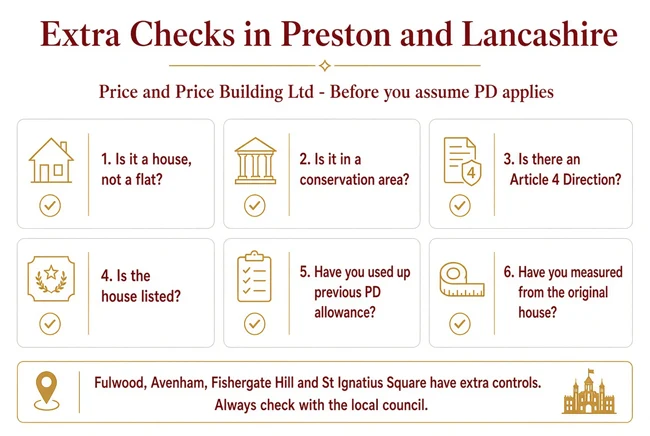
Householder PD applies to houses, not flats or maisonettes. Listed buildings have extra controls. Some rights are reduced or removed in conservation areas, Areas of Outstanding Natural Beauty (now National Landscapes), and where the council has made an Article 4 Direction.
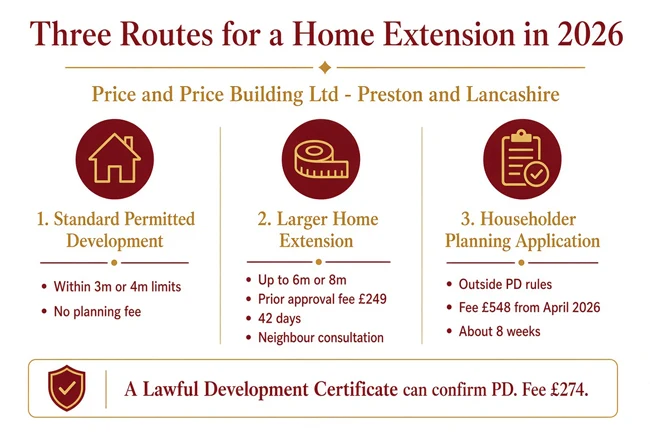
The three routes for an extension in 2026
|
Route |
When it applies |
Typical 2026 council fee (England) |
Typical timescale |
|
Standard permitted development |
Project stays within the smaller PD limits |
No planning fee |
You can start once Building Control is arranged |
|
Larger home extension (prior approval) |
Deeper single-storey rear extension, still within PD |
£249 |
42 days from a valid application |
|
Householder planning application |
Outside PD, or PD rights do not apply |
£548 from 1 April 2026 |
Usually, 8 weeks from validation |
|
Lawful Development Certificate (proposed) |
Optional confirmation that PD applies |
£274 (half the householder fee) |
Usually, 8 weeks |
Fees are set nationally and can be indexed. Always check the Planning Portal fee calculator before you apply. A Planning Portal service charge may also apply.
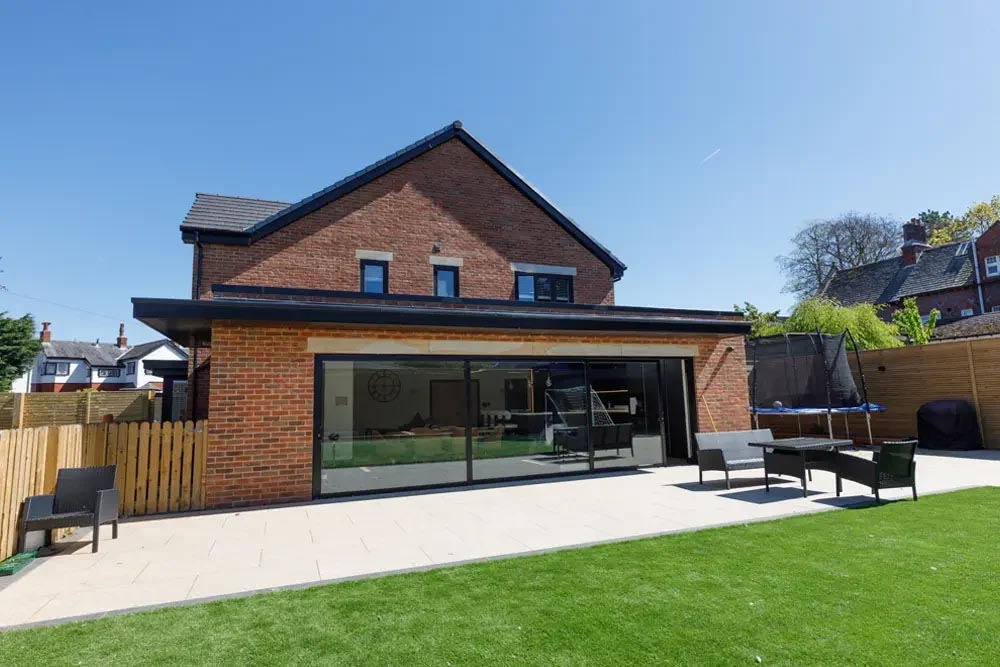
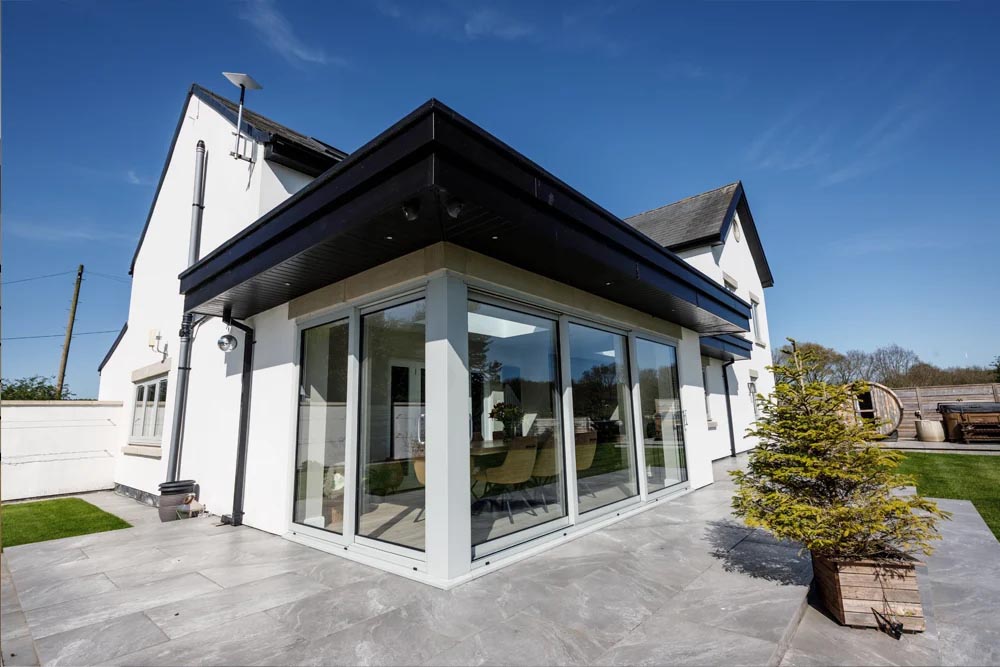
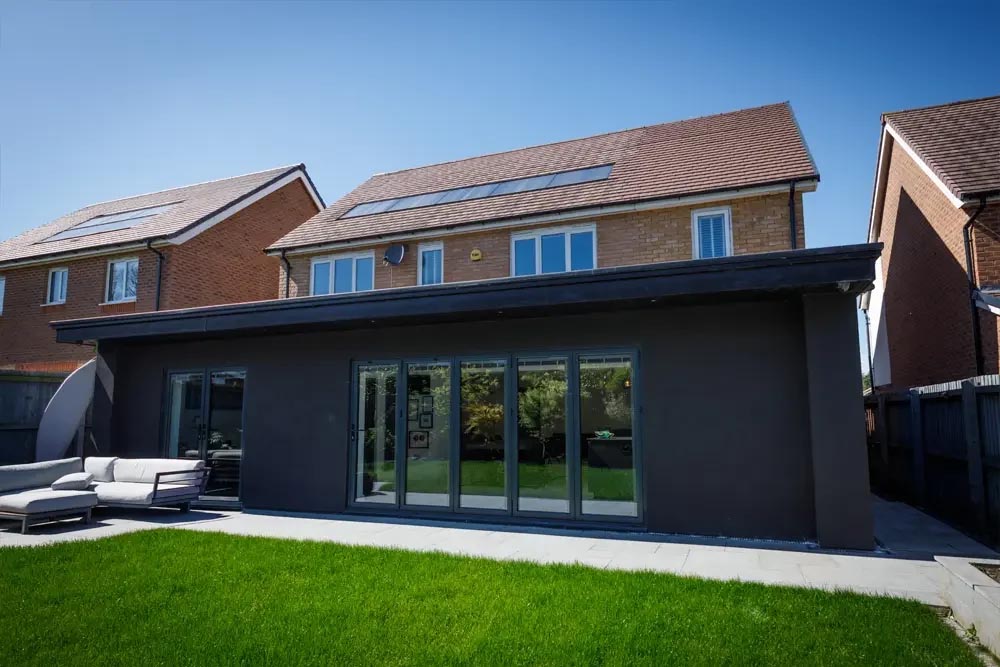
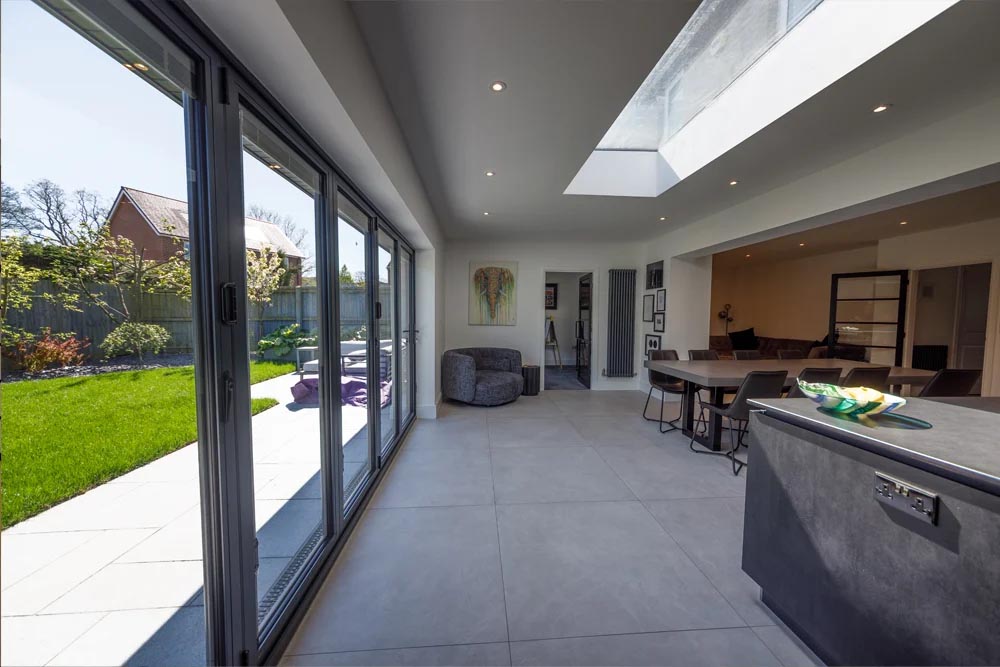
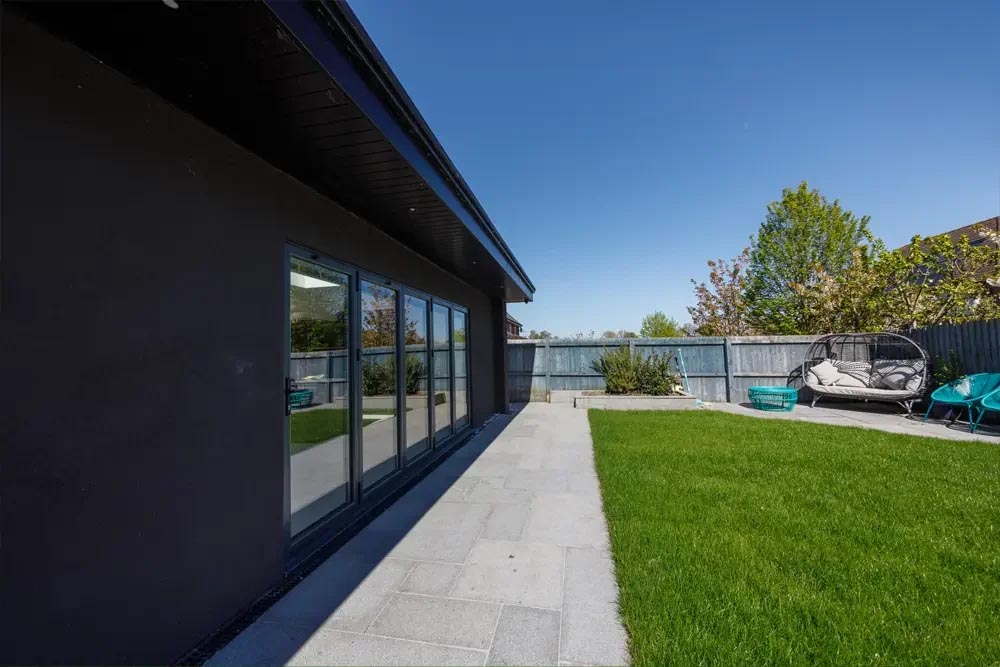
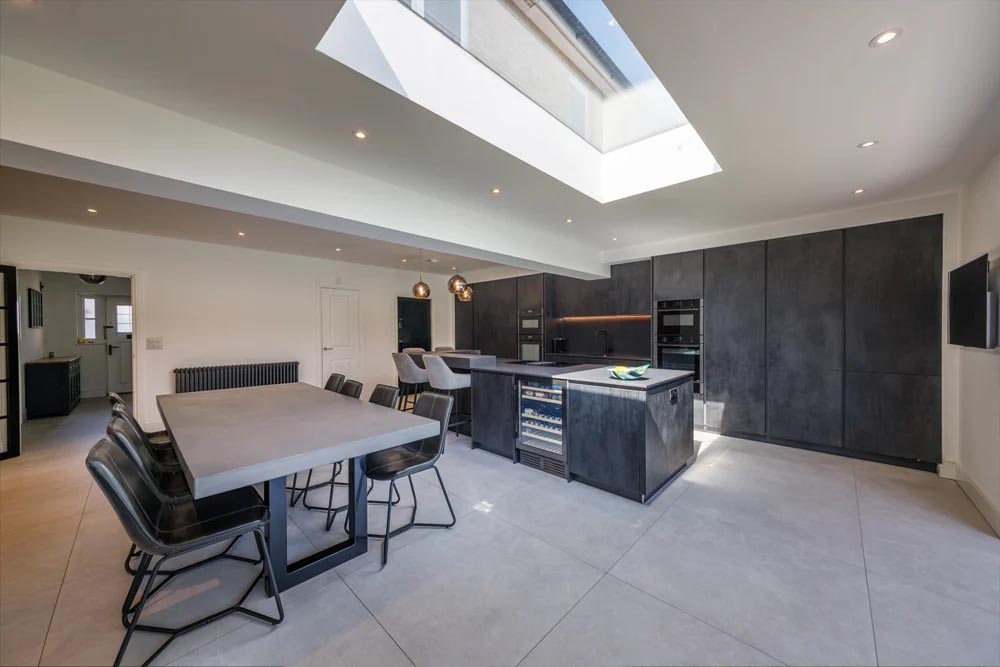
Recent Home Extensions Built By The Price & Price Team
Standard permitted development limits for extensions
These are the main Class A limits for enlarging a house in England, as they stand in 2026.
Single-storey rear extension
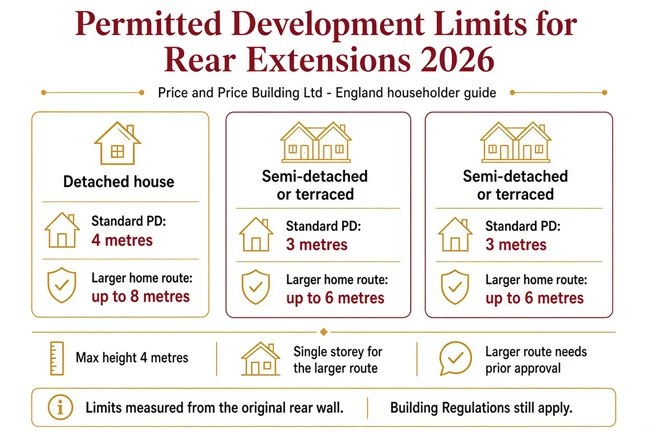
- Detached house: up to 4 metres beyond the original rear wall
- Terraced or semi-detached house: up to 3 metres
- Maximum height: 4 metres
- If any part is within 2 metres of a boundary, eaves height is limited to 3 metres
Larger single-storey rear extension (prior approval needed)
- Detached house: more than 4m and up to 8 metres
- Terraced or semi-detached: more than 3m and up to 6 metres
- Still single storey and still subject to the other Class A rules
- This route is not available in conservation areas or in the Forest of Bowland National Landscape
Two-storey rear extension
- Up to 3 metres beyond the original rear wall
- Must be at least 7 metres from the rear boundary of the garden
- Roof pitch should match the existing house as far as practicable
- No balconies, verandas or raised platforms
Side extension
- Single storey only under PD
- Maximum height 4 metres
- Width no more than half the width of the original house
- On designated land (including conservation areas), side extensions generally need planning permission
Other conditions that apply to almost every PD extension
- It must not sit forward of the principal elevation (usually the front) or a side elevation that faces a highway
- External materials should be of similar appearance to the existing house
- Extensions, outbuildings and other buildings must not cover more than half the land around the original house
- Measurements are taken from the original house — as first built, or as it stood on 1 July 1948 if older. A previous extension already uses up some of your allowance
If you miss even one of these conditions, the work is not permitted development.
How the larger home extension process works
This is often called the Neighbour Consultation Scheme.
- You apply to the local planning authority before work starts.
- You provide a description of the works, a plan and adjoining addresses.
- The council notifies adjoining owners and occupiers.
- Neighbours have 21 days to comment.
- The council has 42 days from a valid application to decide.
- If no decision is issued in that time, prior approval is usually treated as granted.
The council’s test is narrow: the effect on the amenity of adjoining premises. It is not a full design review. If a neighbour objects, the council must consider that amenity impact and can refuse.
You must not start the extension until you have written confirmation that prior approval is not required, prior approval is granted, or the 42 days have passed without a decision.
What is different in Preston and Lancashire
National PD rules apply across England, but local designations change what you can do.
Preston City Council
Covers most of Preston, including Fulwood and Broughton. The council confirms that some work can go ahead without a planning application, but you should check first. The larger-home procedure does not apply in conservation areas.
Preston conservation areas include Ashton, Avenham, Deepdale Enclosure, Fishergate Hill, Fulwood, Harris Children’s Home, Inglewhite, Moor Park, St Augustine’s and St Ignatius Square.
Article 4 Directions remove specific PD rights. In Preston, Article 4 controls apply in parts of Avenham, Fishergate Hill, Fulwood and St Ignatius Square. In those streets, even changing windows or doors can need planning permission. Preston City Council has taken enforcement action where unauthorised windows were fitted in an Article 4 conservation area.
Preston has also made a separate Article 4 Direction aimed at small HMO conversions (C3 to C4). That is about change of use, not typical family extensions, but it shows how locally PD rights can be narrowed.
South Ribble (Penwortham, Lostock Hall, Leyland and nearby)
Same national PD rules. Conservation areas include parts of Penwortham, Hutton, Leyland and Longton. Check the South Ribble map before assuming PD applies.
West Lancashire (Ormskirk and surrounding villages)
Conservation areas and Article 4 Directions exist in several settlements. Newburgh has a wider Article 4 (1) Direction. Side extensions and some alterations are more tightly controlled in those areas.
Wigan (Standish and nearby)
Standish has conservation areas and Green Belt around the village. Conservation-area and Green Belt status can restrict or remove PD rights that would apply on an ordinary suburban plot.
Forest of Bowland
Parts of rural Lancashire sit in this National Landscape. The larger-home extension scheme does not apply there, and other PD rights are more limited.
Green Belt
Some Lancashire villages and edges of towns sit in Green Belt. PD can still exist, but extra limits apply and councils look closely at volume and openness. Do not assume a “standard” rear extension is automatic.
Always check:
- Your local planning authority (Preston, South Ribble, West Lancashire or Wigan)
- Whether the house is listed
- Whether it is a flat
- Whether a previous planning permission removed PD rights by condition
- Trees with a TPO, or trees in a conservation area
Building Regulations still apply
Permitted development is only about planning. You still need Building Regulations for structure, fire safety, drainage, electrics, ventilation and energy performance (Part L).
As of September 2026, most householder extensions in England are assessed against the current Part L standards for existing dwellings. A new Approved Document L (2026 edition) has been published; the main new rules take effect from 24 March 2027 for most work. A competent builder will design the fabric so it passes Building Control now.
Should you apply for a Lawful Development Certificate?
You do not have to. If the work is clearly PD, it is lawful without one.
In practice, an LDC for proposed works is often worth it. It gives you a formal decision from the council that the extension is lawful. That helps if you later sell the house, remortgage, or a neighbour complains. The usual fee for a proposed LDC is half the householder planning fee — £274 from 1 April 2026.
Price and Price Building Ltd can prepare the drawings and help you decide whether an LDC, prior approval or a full householder application is the right route.
Common mistakes that take a project out of PD
- Measuring from the current rear wall instead of the original rear wall
- Forgetting an older extension already used part of the allowance
- Building a wraparound that goes beyond the side elevation
- Using contrasting materials
- Covering more than half the garden once sheds and previous additions are counted
- Starting a 6m or 8m rear extension before prior approval is complete
- Assuming PD applies in a conservation area or Article 4 street
- Treating a flat as if it were a house
- Ignoring Building Regulations because “we don’t need planning”
If work is built outside PD and without planning permission, the council can investigate. For many building operations completed after 25 April 2024, the enforcement period is generally 10 years. That is a long time to live with uncertainty.
How Price and Price Building Ltd can help
We work with homeowners across Preston and Lancashire on single-storey, kitchen, open-plan and two-storey extensions. Our design and build service includes:
- Checking whether PD, prior approval or full planning is needed
- CAD drawings and architectural plans
- Help with Lawful Development Certificates, prior approval and householder applications
- Building Regulations drawings and construction
- Project-managed building work
If you would like us to look at your property, email shaun@priceandprice.co.uk or call 01257 265 673. Consultations and quotes are free and no-obligation.
Frequently asked questions
Do I need planning permission for a single-storey rear extension in Preston?
Often no, if it stays within the 3m or 4m standard limits and meets every other PD condition. A deeper rear extension may still be PD if you use the larger-home prior approval route — unless you are in a conservation area.
Does PD apply in Fulwood Conservation Area?
Some rights are reduced. The larger-home scheme does not apply in conservation areas, and parts of Fulwood have an Article 4 Direction. Check before you start.
Is Building Regulations the same as planning permission?
No. You can have PD and still need Building Control sign-off.
Can I live in the house during the build?
Most clients do. That is a construction issue, not a planning issue.
What if a neighbour objects to a larger home extension?
The council must consider the effect on adjoining amenity. An objection does not automatically mean refusal, but it can.
Frequently Asked Questions – Home Extensions in Lancashire 2026
Do I need planning permission for an extension in Lancashire?
Many single-storey extensions qualify under permitted development. We assess your property and guide you through the correct process.
How much does an extension cost in Lancashire?
Single-storey extensions typically start from £45,000–£80,000. Double-storey extensions usually range from £90,000–£160,000. Every project is different — we provide free, detailed quotes.
Can I live in the house during the build?
Yes, most of our clients do. We work carefully to minimise disruption.
How long does the whole process take from start to finish?
From initial consultation to completion, most projects take between 4 and 8 months depending on size and complexity.
Do you work across all of Lancashire?
Yes — we regularly build extensions in Preston, Fulwood, Broughton, Penwortham, Standish, Ormskirk, Eccleston and surrounding areas.
Guidance is based on the GPDO 2015 (as amended), Planning Portal householder guidance, England planning fees from 1 April 2026, and published information from Preston City Council and neighbouring Lancashire authorities as of September 2026. Always confirm the current position for your address with the relevant council and the Planning Portal.